
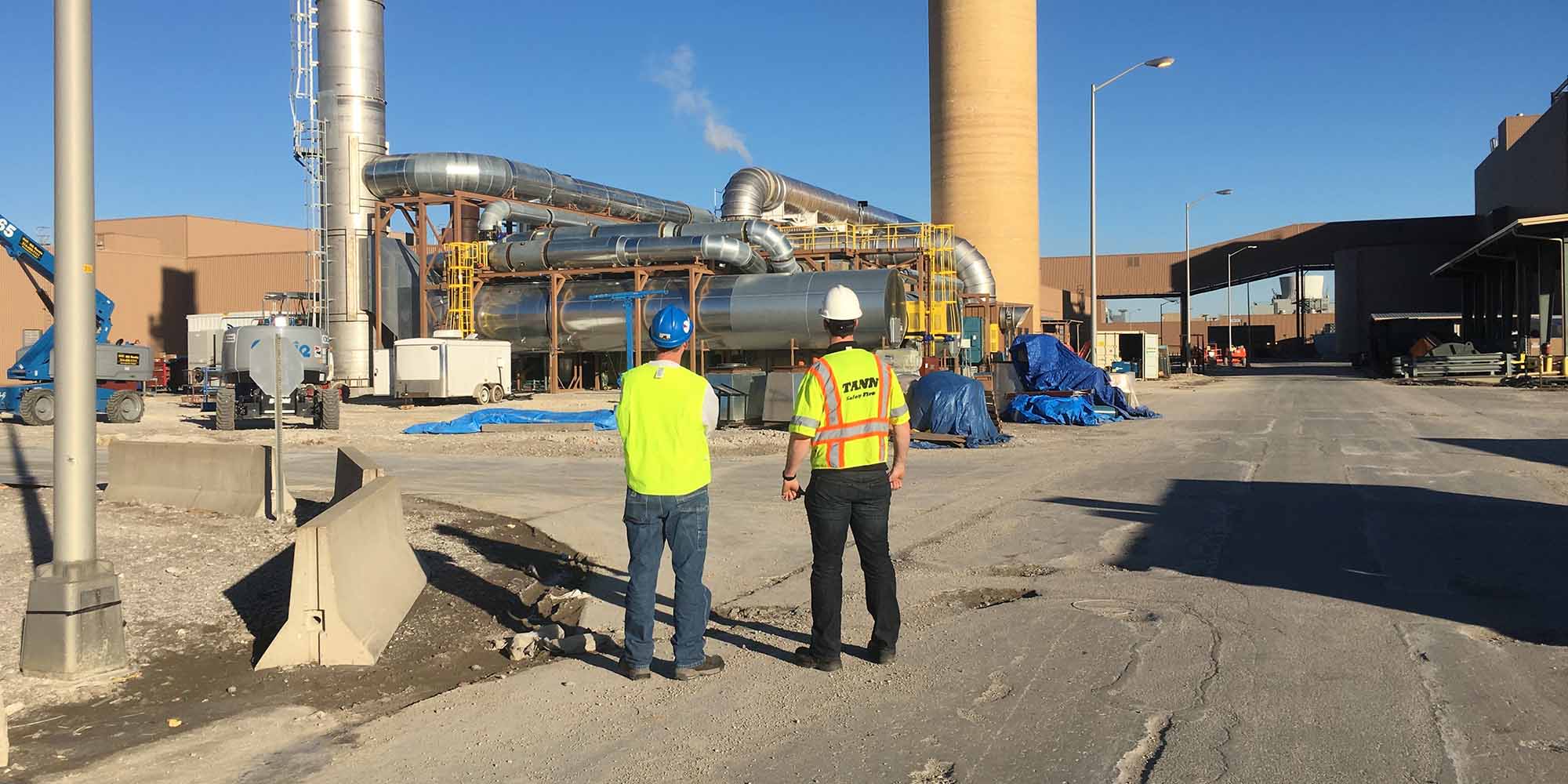
How does a regenerative thermal oxidizer work? At its core, a regenerative thermal oxidizer (RTO) destroys volatile organic compounds (VOCs) and hazardous air pollutants (HAPs) by heating contaminated exhaust to high temperatures. RTOs combine high-temperature oxidation with ceramic heat recovery to destroy VOCs and HAPs while consuming significantly less fuel than other oxidizer types. What makes the system “regenerative” is its ceramic media beds. These beds capture and reuse heat energy between cycles. As a result, RTOs achieve thermal efficiencies of 95% or higher. This combination of high-temperature oxidation and heat recovery has made RTOs the most widely used air pollution control technology in manufacturing.
For plant engineers, Environmental Health and Safety (EHS) managers, and operations leaders, understanding how a regenerative thermal oxidizer works is essential to informed equipment decisions. The operating principles behind an RTO directly affect fuel costs, maintenance planning, and long-term compliance strategy. In this guide, we walk through each stage of the RTO cycle. We also explain the engineering principles behind system performance and cover the components that keep an RTO running reliably for decades.
The Science Behind Regenerative Thermal Oxidation
Every thermal oxidizer relies on the same chemistry. When VOC-laden air reaches a high enough temperature with oxygen present, the organic compounds break down into carbon dioxide (CO₂) and water vapor (H₂O). This process is called thermal oxidation. It requires three conditions: sufficient temperature, adequate residence time, and proper turbulence for complete mixing.
A regenerative thermal oxidizer uses ceramic media beds to capture and reuse heat energy, achieving thermal efficiencies of 95% or higher. This heat recovery sets RTOs apart from other oxidizer types. Recuperative thermal oxidizers use metal shell-and-tube heat exchangers. Those typically recover 60% to 70% of heat energy. Direct-fired thermal oxidizers, by contrast, use no heat recovery at all. Because an RTO reclaims so much thermal energy from its own exhaust, it needs far less supplemental fuel to stay at operating temperature. That difference directly reduces operating costs over the system’s life.
The U.S. Environmental Protection Agency (EPA) recognizes both recuperative and regenerative heat recovery as standard approaches to reducing fuel consumption. The EPA’s Air Pollution Control Cost Manual provides engineering and cost data for both. It confirms that regenerative systems offer the highest thermal efficiency among commercially available oxidizer technologies.
How a Regenerative Thermal Oxidizer Processes Exhaust Air
Understanding how does a regenerative thermal oxidizer work becomes clearer when you follow one complete operating cycle. Specific configurations vary, yet the fundamental sequence stays consistent across all RTO designs.
Step 1: Contaminated Air Enters the System
Process exhaust containing VOCs is drawn into the RTO by the system fan. This airstream may come from paint booths, printing presses, coating lines, or chemical reactors. The fan maintains consistent airflow. It also overcomes the pressure drop created by the ceramic media beds.
Step 2: Air Passes Through the Hot Ceramic Media
The contaminated air enters the first ceramic media bed. This bed was heated during the previous cycle. As cool, dirty air passes upward through the media, stored heat energy transfers to the airstream. By the time air exits the top of the bed, it has been preheated to near the combustion chamber temperature. This step gives the RTO its exceptional thermal efficiency.
Step 3: Oxidation in the Combustion Chamber
The preheated air enters the combustion chamber. There, a burner raises the temperature to approximately 1,500°F. At that temperature, with adequate residence time and turbulence, VOCs oxidize into CO₂ and water vapor. Properly designed regenerative thermal oxidizer systems achieve VOC destruction efficiencies of up to 99%, meeting or exceeding the requirements of most EPA and state air quality permits. High-temperature insulation lines the chamber to retain heat and maintain consistent conditions.
How the Regenerative Thermal Oxidizer Cycle Completes
After oxidation, the clean hot air continues through the system. The remaining steps recover heat and prepare the RTO for its next cycle. Knowing how does a regenerative thermal oxidizer work at this stage helps explain why fuel savings are so significant.
Step 4: Clean Air Heats the Outlet Media Bed
The clean, hot air flows down through a second ceramic media bed. As it passes through, thermal energy transfers from the air into the ceramic. This heats the bed for the next intake cycle. The clean air then exits the system at a much lower temperature. Because the ceramic media captures and stores most of the thermal energy from each cycle, an RTO requires only a small amount of supplemental fuel to maintain operating temperature. Most of its heat energy has been stored in the ceramic media. Only a small fraction of the total heat escapes the system, which is why supplemental fuel demand remains low during steady-state operation.
Step 5: Valves Switch and the Cycle Reverses
After a set interval, flow-directing valves switch the airflow direction. The bed that was absorbing heat now releases it to preheat incoming contaminated air. Meanwhile, the bed that was releasing heat now absorbs it from the clean exhaust. This alternating cycle repeats continuously during operation. It maintains consistent destruction efficiency while minimizing fuel consumption. The switch interval is controlled by the PLC and calibrated during commissioning to match the specific thermal characteristics of the media beds.
Ceramic Media in a Regenerative Thermal Oxidizer
Ceramic media is the heart of every regenerative thermal oxidizer. These engineered heat exchange elements store and release thermal energy during each cycle. Their design directly affects system efficiency, pressure drop, and maintenance needs.
Two primary media types are used in RTO systems. Structured ceramic media features precisely engineered channels that provide uniform airflow paths. This design results in a smaller footprint and a lower overall weight. Random-packed media, often ceramic saddles, works well for most applications that include particulate. Both types are installed in beds with a depth of 5 to 8 feet. That depth provides sufficient thermal mass for effective heat exchange.
Ceramic media beds in a regenerative thermal oxidizer typically last 15 to 20 years for random saddle media, with structured media replacement cycles of 5 to 10 years. Operating conditions affect media lifespan. Over time, ceramic media can experience degradation from thermal cycling, chemical exposure, or particulate buildup. Regular inspections help identify when performance has declined enough to justify replacement. Signs of media degradation include increasing pressure drop across the beds, declining thermal efficiency, and visible damage during internal inspections. Our ceramic media services include evaluation, replacement, and disposal of spent media for any make or model oxidizer.
Two-Chamber vs. Three-Chamber RTO Configurations
Most regenerative thermal oxidizer systems use either a two-chamber or three-chamber design. Each has distinct operating characteristics that affect performance. The choice between them depends on the destruction efficiency required by your air permit and the VOC concentrations in your exhaust stream.
A two-chamber RTO alternates airflow between two ceramic media beds. During valve transitions, a brief period occurs where untreated air can bypass the combustion chamber. For many applications, this design still provides excellent destruction efficiency at a lower capital cost. Two-chamber systems work well for facilities where permit requirements allow a small margin of untreated emissions during valve switching.
A three-chamber RTO adds a third ceramic media bed. It acts as a purge chamber during valve transitions. While one bed handles the inlet cycle and another handles the outlet cycle, the third bed undergoes a purge. That purge pushes any residual untreated air back into the combustion chamber. Three-chamber RTOs inherently achieve higher destruction efficiency than two-chamber designs because the purge cycle captures residual VOCs that would otherwise escape during valve transitions. Pharmaceutical and chemical processing applications often specify three-chamber systems. In those industries, permit limits are strict and destruction efficiency requirements leave little room for bypass emissions.
Key Components of a Regenerative Thermal Oxidizer
Beyond the ceramic media and combustion chamber, several components are critical to RTO reliability. Understanding how does a regenerative thermal oxidizer work requires knowing the role each component plays in maintaining consistent destruction efficiency and uptime.
Flow-Directing Valves
Valves control airflow direction through the ceramic media beds. Their reliable operation is essential to consistent destruction efficiency. Proper switch timing ensures full bed utilization before the cycle reverses. Valves require an annual inspection to verify proper operation. Worn seals or slow actuation can reduce performance if left unaddressed.
Burner System
The burner provides supplemental heat to keep the combustion chamber at operating temperature. In many applications, high VOC concentrations produce enough oxidation heat to sustain the chamber temperature on their own. This condition is called self-sustaining or autothermal operation. It requires no supplemental fuel at all. Modern burner controls modulate fuel input based on real-time temperature readings.
System Fan
The process fan moves contaminated air through the entire system. It must overcome the pressure drop from ductwork, ceramic media beds, and the combustion chamber. Fan sizing accounts for media pressure drop and required process airflow. An undersized fan reduces airflow and compromises destruction efficiency, so accurate engineering data matters during system design. Standard RTO systems handle 5,000 to 80,000 standard cubic feet per minute (SCFM). Large installations handle up to 400,000 SCFM.
PLC Controls
A programmable logic controller (PLC) manages the entire RTO operation. It handles valve switch timing, burner modulation, temperature monitoring, safety interlocks, and fault diagnostics. Modern PLC systems also enable remote monitoring. That gives operators visibility into performance from anywhere in the facility. Alarm logging and trend data from the PLC also support compliance reporting and help maintenance teams identify issues before they affect system uptime.
Why Regenerative Thermal Oxidizers Outperform Other Types
Now that you understand how does a regenerative thermal oxidizer work at each stage, the performance advantages become clear. The 95%+ thermal efficiency means an RTO needs only a fraction of the fuel other oxidizer types require. A recuperative thermal oxidizer achieving 70% heat recovery requires roughly six times more supplemental fuel than an RTO at 95% thermal efficiency under identical conditions. Over 20 to 30 years of operation, that fuel savings adds up to a substantial difference in total cost.
Regenerative thermal oxidizer systems routinely operate for 20 to 30 years with 99%+ uptime when properly maintained. Long service life, low operating costs, and high destruction efficiency produce a total cost of ownership that other oxidizer technologies rarely match. Facilities that invest in preventive maintenance, including regular valve inspections and media evaluations, consistently achieve the best long-term performance. Our guide to RTO operating costs provides a detailed breakdown of fuel, energy, and lifecycle cost factors.
For a side-by-side comparison of all four major oxidizer types, see our oxidizer types comparison guide. It covers how each system handles heat recovery, destruction efficiency, and capital cost.
When to Choose a Regenerative Thermal Oxidizer
RTOs are the best fit for processes with moderate to high airflow and relatively low VOC concentrations. RTOs are the best fit for continuous manufacturing processes with moderate to high airflow volumes and VOC concentrations below 10% of the lower explosive limit. Common industries include automotive painting, printing and coating, pharmaceutical manufacturing, packaging, and chemical processing. If your facility produces a continuous exhaust stream with consistent VOC loading, a regenerative thermal oxidizer will almost always deliver the lowest operating cost.
Facilities running multiple process lines often benefit from a single centralized RTO. Ductwork connects each source to the oxidizer, and the system handles varying loads throughout the production schedule. This approach reduces capital cost compared to installing separate abatement equipment at each emission point.
Facilities with very high VOC concentrations, very low airflow, or intermittent batch processes may benefit from other oxidizer types. In those situations, a recuperative thermal oxidizer, catalytic oxidizer, or direct-fired system may fit better. Applications with catalyst poisons in the exhaust stream typically require a thermal solution rather than a catalytic one. Every application is different. The right system depends on your specific exhaust characteristics, destruction efficiency requirements, and compliance obligations.
Final Thoughts
Understanding how does a regenerative thermal oxidizer work is the first step toward selecting the right emission control system. Ceramic heat exchange, high-temperature oxidation, and continuous cycle reversal together give RTOs a fuel efficiency advantage that no other oxidizer type can match at comparable airflow volumes. That advantage directly reduces fuel costs and operating expenses over the system’s life. For facilities facing VOC compliance requirements, an RTO delivers reliable destruction efficiency, low operating costs, and a system built to run for decades.
The engineering behind each stage of the RTO cycle contributes to long-term reliability and cost control. Whether you are replacing aging equipment, expanding production, or installing emission controls for the first time, RTO technology gives you a clear path to compliance.
Learn More About Our RTO Systems
Explore how system design and integration impact long-term performance.
Need Help Evaluating Your Application?
Our team can help assess your system requirements and long-term operating considerations.
TANN Corporation’s engineers have been designing regenerative thermal oxidizer systems for 40+ years, serving manufacturers across every industry with VOC compliance requirements. Our engineering team evaluates each application individually, recommending system configurations optimized for specific exhaust characteristics and compliance obligations. From initial assessment through installation and decades of ongoing support, we deliver complete emission control solutions. Contact us today for a free quote or to learn more.