


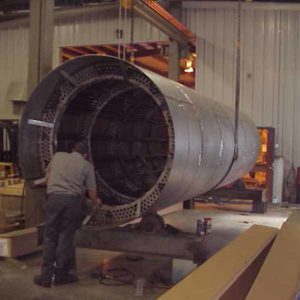

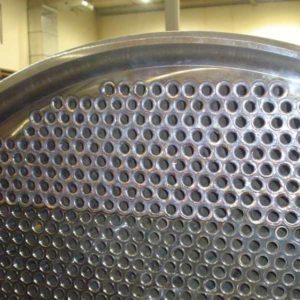
Recuperative thermal oxidizers use a stainless steel heat exchanger to preheat the incoming process air to within 400°F of the combustion temperature prior to entering the combustion chamber.
The burner will provide the remaining energy to heat the process air to the combustion chamber temperature of ~1,400°F. In the combustion chamber, the VOCs within the process exhaust will convert to CO2 and H2O.
This 1,400°F air, now clean, will pass through the opposite side of the heat exchanger, thus providing the energy for the incoming process air.
Most recuperative oxidizers will utilize a shell and tube style heat exchanger. The shell and tube design will provide a longer life and provide access for cleaning if needed.
Recuperative heat exchangers can have thermal efficiencies from 40% to 80% depending on the application.
The TANN Advantage
- Custom and standard recuperative designs
- Embedded combustion chamber to reduce footprint
- 99%+ destruction efficiencies
- Sliding tube design to reduce failure
- Raw gas burner for optimum efficiency
- Best warranty in the industry
Applications
Although regenerative oxidizers account for the majority of oxidizer sales in today’s market, recuperative oxidizers still have a place in the pollution control industry.
Below are some applications where recuperative oxidizers work better than others.
- Silicone Process – A recuperative oxidizer can be designed so the tubes can be cleaned periodically.
- Corrosive Environment – The oxidizer can be manufactured from corrosion resistant steels.
- Heat Recovery – The lower thermal efficiencies will produce a higher exhaust temperature in the exhaust stack. This energy can be used to heat air for the process or throughout the plant.
Talk to an Engineer About Your Recuperative Thermal Oxidizer Project
TANN can help review your application and determine whether a recuperative thermal oxidizer is the right fit for your process, operating conditions, and heat recovery goals.