
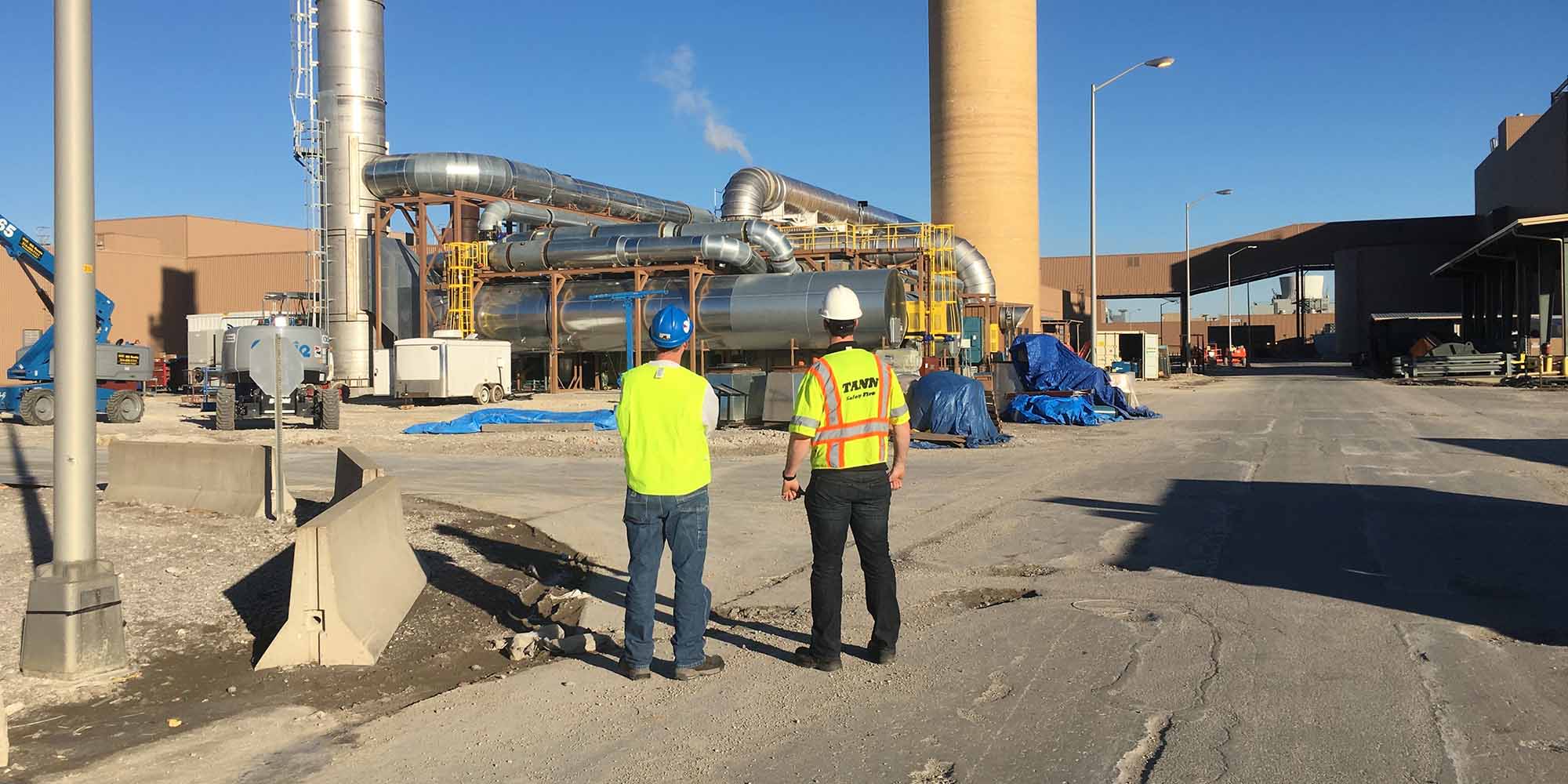
Efficient RTOs routinely deliver 95–97% thermal efficiency and 99%+ destruction efficiency—often running self-sustaining with zero natural-gas burn at load. When engineered and operated correctly, RTO efficiency cuts total facility energy use by 20–40% while protecting permits and air quality.
Moreover, efficiency is not a single setting; it is a balance of design choices (media, valves, chamber geometry), operating discipline (temperature, residence time, switching), and upkeep (seals, insulation, instrumentation). The payoff shows up as lower fuel, lower CO₂, and higher uptime.
Understanding RTO Efficiency Fundamentals
Know the two efficiencies:
- Thermal efficiency: percentage of heat recovered by ceramic media and returned to inlet air; best-in-class 95–97%.
- Destruction efficiency (DRE): percentage of VOC/HAP removed; target ≥99% under design conditions.
How regeneration works: hot, clean gas heats a ceramic bed; valves reverse every 2–4 minutes; the next cycle transfers that stored heat to the incoming VOC stream.
Energy balance essentials:
- Inputs: inlet air temperature, VOC heating value, burner fuel.
- Losses: valve leakage, wall/duct heat loss, stack sensible heat.
- Levers: media selection and depth, switching timing, insulation quality.
Primary performance drivers:
- Ceramic media condition: cleanliness, crack-free blocks, correct orientation.
- Valve tightness: low bypass keeps hot gas in the beds and boosts recovery.
- Insulation integrity: eliminates thermal bridges that erode efficiency.
- Flow distribution: even velocity profile across beds for uniform heat exchange.
Achieving Self-Sustaining RTO Operation
What “self-sustaining” means: the VOC heating value alone maintains the combustion zone at ~1,400–1,500°F with no supplemental gas during steady state.
Typical prerequisites:
- VOC load: ~3–4% of composite LFL (application-specific).
- Thermal efficiency: near the 95–97% range.
- Safe margin: operate below 25% LFL with verified mixing and monitoring.
Heat-balance tactics that enable fuel-free runs:
- Tight valves: minimize bypass to keep beds hot.
- Optimized switching: time intervals matched to bed size and duty.
- Low losses: high-quality refractory/insulation; sealed access points.
- Smart controls: adaptive temperature trim and LFL supervision.
Economic upside:
- Fuel avoided: often $50k–$500k+ per year, size and duty dependent.
- CO₂ reduced: lower combustion equals lower greenhouse gas.
- Price resilience: less exposure to gas price swings.
Thermal Efficiency Optimization Strategies
Ceramic media selection and layout:
- Structured media: high surface area with lower ΔP; typically best for high flows.
- Random saddles: robust in harsher services; design for slightly higher depth.
- Zoning: top layers for fouling resistance; lower layers for high transfer.
- Bed depth: sized to reach target outlet temperature without excess ΔP.
Valve and timing optimization:
- Seal integrity: metal-to-metal or advanced elastomers with verified leak rates.
- Actuation accuracy: calibrated stroking for repeatable timing.
- Interval control: adjust 2–4 minute cycle to process volatility and season.
Chamber and duct details:
- Flow distribution: turning vanes, perforated plates, and straight runs before beds.
- Pressure drop management: balance fans, dampers, and bed ΔP to cut kW.
Insulation and heat-loss control:
- Refractory quality: thickness and density matched to duty.
- Thermal bridges removed: continuous jacketing, insulated supports, sealed penetrations.
- Surface temperature audits: IR scans to find and fix hot spots.
Controls that pull it together:
- Predictive logic: anticipates load swings and pre-positions valves.
- Adaptive setpoints: trims burner and switching to sustain target temps.
- KPI dashboards: live thermal efficiency, DRE, LFL %, ΔP, fuel and kWh.
Energy Recovery and Heat Integration
Secondary recovery options:
- Process air preheat: reclaim sensible heat for ovens/dryers.
- Hot water or glycol loops: feed make-up air units or process tanks.
- Steam generation: use a waste-heat exchanger on RTO exhaust when temps allow.
- Space heating/cooling: tie into hydronic heat or absorption chilling.
Integration tips:
- Match grade to need: temperature levels aligned to end-use loads.
- Control interactions: avoid starving the RTO of back-pressure headroom.
- Meter value: track recovered MMBtu to prove ROI.
Factors Affecting RTO Efficiency Performance
Process air characteristics:
- Temperature and humidity: colder, wetter air increases heat demand.
- Flow variability: turndown strategy needed for nights/weekends.
- Chemistry: halogens/sulfur can affect media life and temperature profiles.
VOC concentration and composition:
- Heating value: determines self-sustain threshold.
- Mixtures: blended LFL and flame speed influence safe setpoints.
Operating temperature and residence time:
- Combustion zone: typically 1,400–1,500°F with adequate seconds of residence.
- Uniformity: avoid hotspots/cold spots with good mixing.
Maintenance condition:
- Media cleanliness: vacuum or wash where approved; restore heat transfer.
- Valve seals: inspect/replace before leakage grows.
- Insulation: repair jacketing; fix water ingress immediately.
Environment and seasonality:
- Winterization: account for cold starts and stack plume.
- Wind loads: stabilize draft to protect temperature control.
Measuring and Monitoring RTO Efficiency
Thermal efficiency calculation:
- Inputs required: inlet/outlet temperatures, flows, fuel, and power.
- Method: standard heat-balance formulas trended over time.
Continuous monitoring and alerts:
- Core tags: bed temps, combustion temp, valve state, ΔP, fuel flow, LFL %.
- Dashboards: rolling efficiency %, DRE %, and cost per hour.
Performance testing cadence:
- Thermal verification: after major maintenance or annually.
- DRE testing: per permit and post-optimization.
- Benchmarking: against historical baselines and peer sites.
Diagnosing losses:
- Heat map review: IR scans + temp profiles identify leakage/bridges.
- Step tests: vary switching intervals to see bed response.
- Component checks: isolate media fouling vs. valve bypass vs. insulation.
RTO Efficiency vs Operating Costs
Fuel analysis:
- From 90% → 95% thermal efficiency: typically 40–60% less fuel consumed for the same duty.
- Self-sustaining periods: convert a cost center into recovered energy.
Electrical analysis:
- Fan power dominates: optimize ΔP with cleaner media and balanced flows.
- Controls efficiency: smarter tuning reduces hunting and saves kWh.
Total cost approach:
- Fuel + electricity − recovered heat = net energy cost.
- Payback window: most optimization projects return in 1–3 years.
Lifecycle view:
- Fewer hot-end repairs: cooler shells and stable temps extend asset life.
- Predictable spend: planned PM beats emergency seals and overtime.
Advanced Efficiency Technologies
High-efficiency ceramic media:
- Enhanced surfaces: +5–15% transfer vs. standard; lower ΔP at scale.
- Segmented cassettes: easier maintenance and zoning.
Low-leakage valves:
- Metal-seat, precision actuation: leakage <1%; +2–4% thermal efficiency gain common.
Recuperative add-ons:
- Exhaust HX: reclaim another 15–25% of available heat for plant use.
Flameless oxidation concepts:
- Distributed combustion: near-isothermal zones; high efficiency with low NOx.
Hybrid RTO/RCO (regenerative catalytic oxidizer):
- Dual mode: catalytic at low solvent; thermal at higher loads for best economics.
Industry Efficiency Applications
Automotive paint lines:
- 50,000–100,000 SCFM: self-sustaining most shifts; annual fuel avoidance in the $200k–$800k range.
Chemical processing:
- Advanced controls + media zoning: +3–8% efficiency with mixed solvents.
Pharmaceutical:
- Validation-friendly gains: 96–98% thermal efficiency with rigorous documentation.
Food processing and odor control:
- High moisture strategies: preheat and drainage features; heat recovery for space/process loads.
Print and packaging:
- Variable duty: adaptive switching and setpoint trims maintain 94–96% efficiency across shifts.
Future Trends in RTO Efficiency
AI-assisted control: predictive algorithms tune switching and burner trim in real time.
Predictive maintenance: condition-based service on valves, fans, and media to preserve efficiency.
Sustainability integration: recovery tied to plant heat networks and renewable initiatives.
Smart oxidizer platforms: IoT telemetry, cloud analytics, and autonomous optimization.
Final Thoughts
If you can measure it, you can improve it—and RTO efficiency is highly improvable. With the right media, tight valves, solid insulation, and adaptive control, facilities hit 95–97% thermal efficiency, maximize heat recovery, and run self-sustaining when the load allows. The result is lower energy cost, lower emissions, and higher reliability—year after year.
TANN Corporation’s engineers have been designing regenerative thermal oxidizer systems for 40+ years, serving manufacturers across every industry with VOC compliance requirements. Our engineering team evaluates each application individually, recommending system configurations optimized for specific exhaust characteristics and compliance obligations. From initial assessment through installation and decades of ongoing support, we deliver complete emission control solutions. Contact us today for a free quote or to learn more.